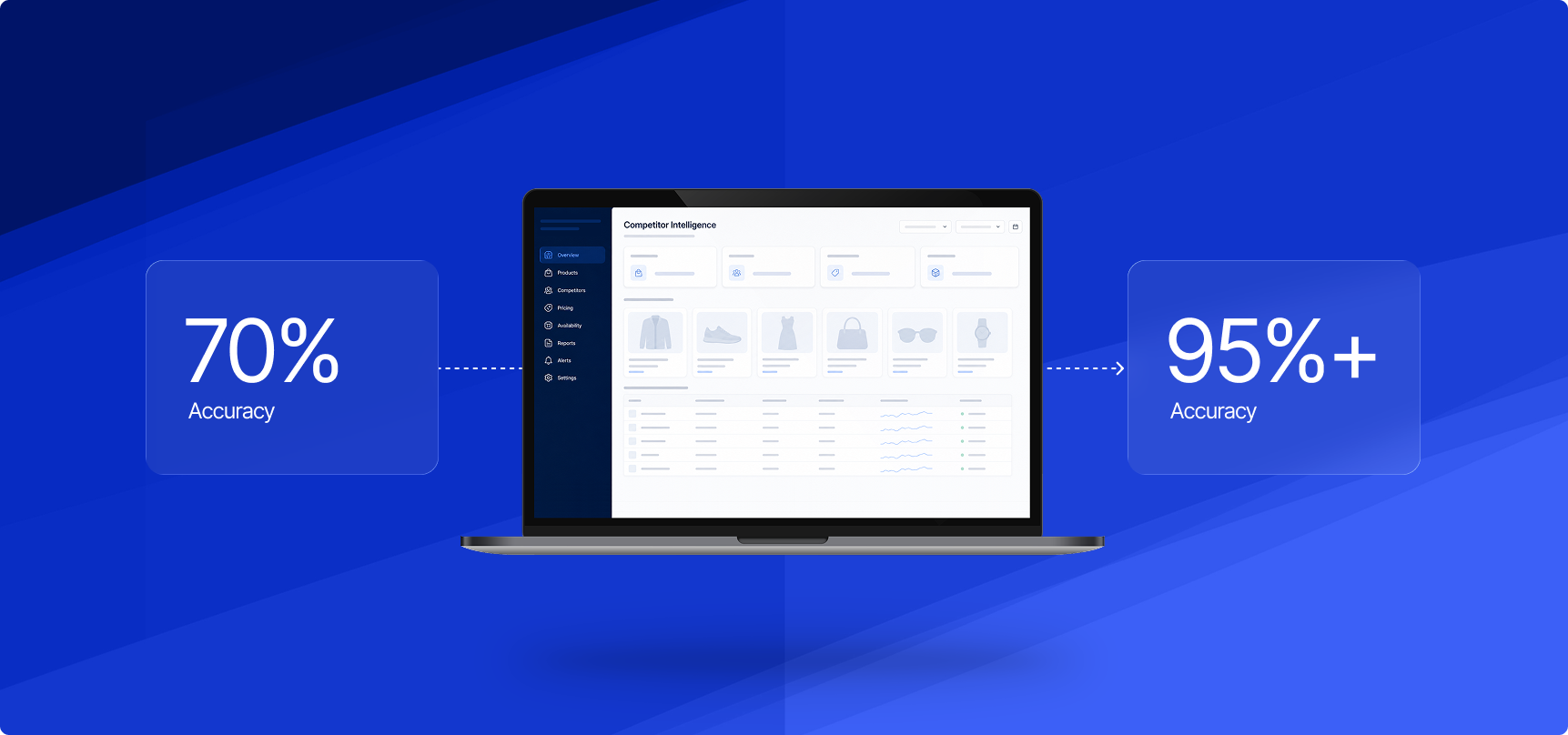
Competitor data intelligence accuracy from ~70% to 95%+
Software Eng, Cloud, Data Integration
Fashion Retail Brand
Python, AWS Lambda, PostgreSQL, S3

A third-party tool with 70% accuracy and workflows that didn't fit the business
This is a fashion retail brand that tracked competitor pricing, assortment, and promotions across multiple market channels to drive merchandising and pricing decisions. The problem was twofold: the third-party competitive intelligence tool captured accurate, usable data only ~70–75% of the time, and its rigid, one-size-fits-all workflows couldn't be adapted to how the merchandising team actually worked.
Every failed data pull meant a blind spot — a competitor price change missed, a promotion spotted late, and pricing decisions made on stale or incomplete data. And because the tool's workflows couldn't be customized, analysts spent hours exporting, reshaping, and manually verifying data just to make it usable.
The brand evaluated alternatives, but switching tools meant inheriting the same limitations: fixed workflows, capped accuracy, and no control over what was monitored or how. Building in-house meant solving a problem most off-the-shelf tools never cracked, capturing competitor market data reliably, at scale, in a system shaped around their own workflows. They chose to build.

A custom competitor analysis system across four market data channels built to outperform, not just replace
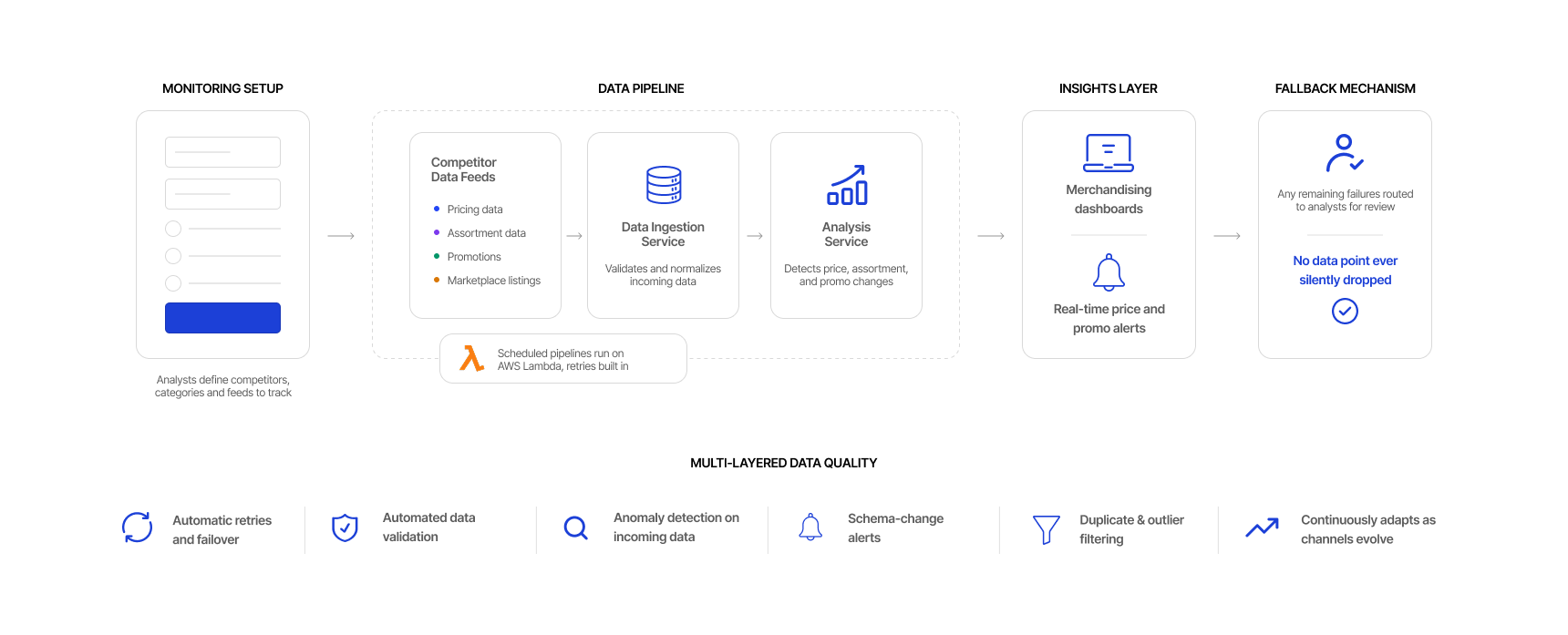
We designed and built a complete in-house competitive intelligence system from scratch. The architecture separated concerns cleanly: an Ingestion Service to collect and normalize competitor data from each channel, an Analysis Service to detect price moves, assortment changes, and promotional activity, and a unified data layer feeding dashboards the merchandising team already used.
The execution layer runs on AWS Lambda for scalability, using pattern-based data collection to interact with each channel. A fallback mechanism routes any failed capture for retry, ensuring no data point is silently dropped.
The hardest part wasn't the collection itself, it was resilience. Each channel changes independently and without warning. We built a multi-layered defense: rotating capture strategies, automated validation of incoming data, mismatch alerts on unexpected structure changes, and detection of catalog or pricing anomalies. The system was designed to adapt continuously as channels change their structure.
95%+ success rate. 60% less manual work. Built around business needs.
The system was designed, built, and deployed in approximately 6 weeks. Capture accuracy rose from ~70% to over 95%, and workflows built around how the merchandising team actually works cut analyst hours spent on manual verification and rework by roughly 60–70%. The brand now owns its entire competitive intelligence stack, no vendor limitations, full control over which competitors and channels it monitors.
~95%+
~60%
6 weeks
ElasticSearch API, 96% response time improvement
Legacy schema migration, 5M+ records, zero downtime
Legacy schema migration, 5M+ records, zero downtime
React Native to native iOS, seamless migration