SFCC re-architecture: 40% faster page loads, 7,500 orders per hour, zero downtime at peak

Commerce Eng, Platform Modernization, Cloud
Plus-size fashion eCommerce, multi-brand
TypeScript, NestJS, Next.js, SFCC, Redis, AWS ECS

A monolithic commerce platform that couldn't handle what was coming
This is one of the largest multi-brand eCommerce platforms for plus-size fashion, serving millions of customers across multiple brand storefronts. Their platform ran on Salesforce Commerce Cloud's SFRA architecture a monolith where frontend and backend were tightly coupled, making it increasingly difficult to scale the high-traffic flows that drive revenue: product detail pages, cart, and checkout.
Backend performance bottlenecks, inefficient API responses, and a lack of caching at critical points were limiting order throughput and slowing page loads. The platform was functional at normal traffic, but peak retail events Black Friday, Cyber Monday, and seasonal promotions exposed the limits of the architecture in ways that directly threatened revenue.
The team had attempted incremental optimizations within SFRA backend tuning, configuration changes but the monolithic architecture and tightly coupled logic prevented any meaningful scalability improvement. The fix couldn't be incremental. It required a fundamental re-architecture.

Headless microservices architecture with backend performance as the core focus
We re-architected the platform from a monolithic SFRA system to a headless, microservices-based architecture. The critical insight was that this wasn't primarily a frontend modernization the largest performance gains came from restructuring the backend.
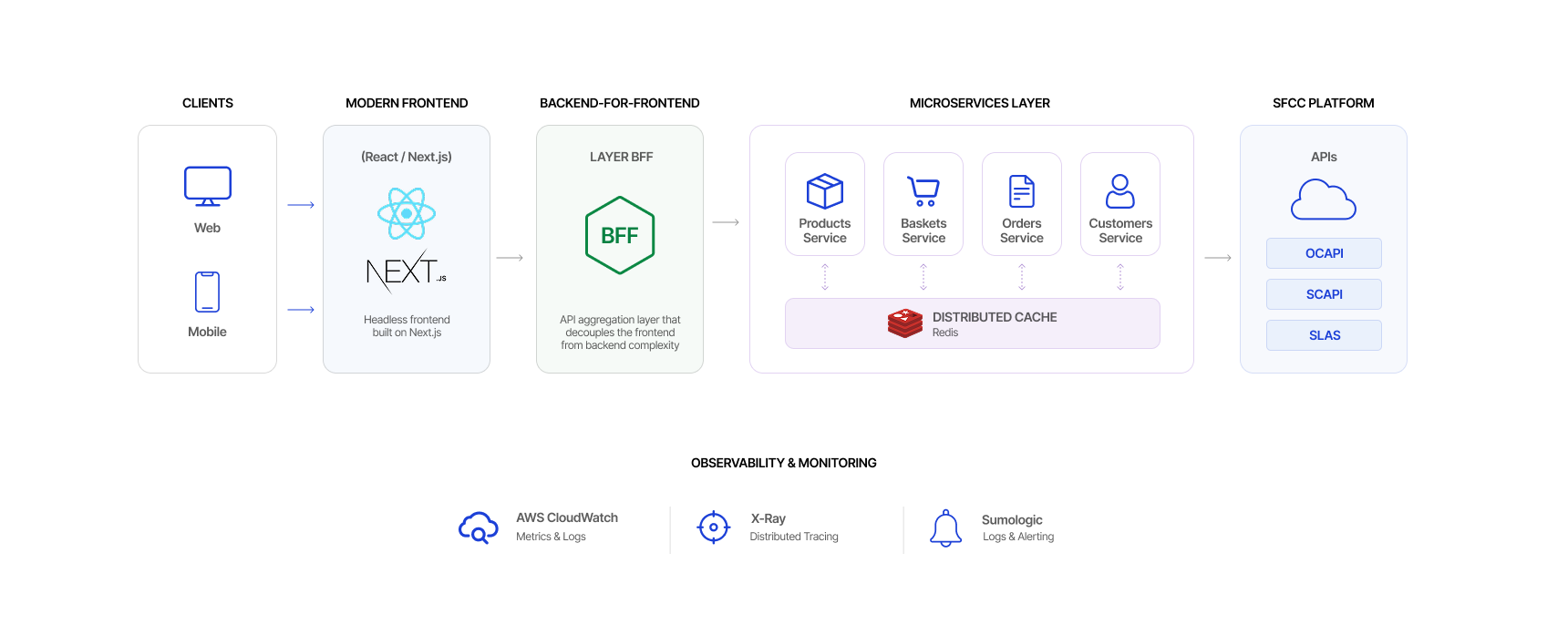
The build covered six major workstreams:
NestJS microservices for commerce
Separate services for products, baskets, orders, and customers each orchestrating SFCC's OCAPI, SCAPI, and SLAS APIs. Decoupled deployment and scaling per domain.
Backend-for-Frontend (BFF) layer
API aggregation layer that decoupled the frontend from backend complexity. The BFF composed responses from multiple services into clean, frontend-optimized payloads.
Distributed caching with Redis
Redis caching implemented across services for configuration data, product catalog, and high-traffic endpoints. Eliminated repeated upstream calls to SFCC during peak load.
Order placement flow optimization
Rebuilt the checkout and order flow, removing bottlenecks in the placement pipeline to increase throughput under load. This was the single largest contributor to the 7.5K orders/hour result.
Observability and monitoring
AWS CloudWatch, X-Ray, and Sumologic instrumented across all services. Performance tracing, error diagnosis, and alerting built in from day one not added as an afterthought.
Modern frontend (React / Next.js)
Headless frontend built on Next.js, but the frontend migration was secondary to the backend re-architecture that drove the performance improvements.
Peak season handled. No incidents. 2× faster shipping of features.
The re-architected platform handled Black Friday and Cyber Monday traffic with zero critical downtime processing 7,500 orders per hour at peak. Page load times improved by 40% across PDP, cart, and checkout flows. The decoupled architecture enabled approximately 2× faster release cycles, and the move to a Node.js/TypeScript ecosystem broadened the available talent pool significantly compared to the proprietary SFCC development environment.
~40%
7.5K/hr
2×
Data pipeline optimization, 96% faster execution
Peak-season scaling with zero critical downtime
Peak-season scaling with zero critical downtime
Decoupled architecture, 2× faster releases